






Mother Nature, or Mother Earth, represents the nurturing, life-giving, and destructive forces of the natural world, embodied as a female deity or universal spirit across various cultures and times. Revered and personified as a deity or goddess, Mother Earth has many names and faces. The underlying belief is that earth is a life-giving and nurturing motherly entity.
The Mother Goddess, or Great Goddess, is a composite of various feminine deities from past and present world cultures, worshiped by modern Wicca and others broadly known as Neopagans. She is sometimes identified as a Triple Goddess, who takes the form of Maiden, Mother, and Crone archetypes. She is described as Mother Earth, Mother Nature, or the Creatrix of all life. She is associated with the full moon and stars, the Earth, and the sea. In Wicca, the Earth Goddess is sometimes called Gaia.
The Māori are indigenous Polynesian people of New Zealand. The Encyclopedia of New Zealand states that in Māori tradition, Papatūānuku is the land. She is a mother earth figure who gives birth to all things, including people, trees, and birds and then nourishes them. Traditional Māori culture aligns women with the land, because the land gives birth to humankind just as women do. As the world was born from Papatūānuku, so humankind is born from women. The Maori word for a woman’s womb, translates to mean “the house of humanity”, and is regarded as the same as the womb of earth.
The Saami, a Finno-Ugric people, historically known in English as Laplanders, live today in four countries: Norway, Sweden, Finland and Russia. Folklorist and storyteller Niina Niskanen tells us “Mattarahkka was the primal mother, the goddess of earth. She was the beginner of all life. Her job was to receive the soul and the spirit of the child from the sky god Radien and give the breath of life to the child in the womb. Women turned to her during childbirth.
-
Maya – Akna
-
Lepcha – It Bunoo
-
Maori – Papatūānuku
-
Native Hawaiian – Papa
-
Huichol – Tatei Yurianaka
-
Saami –Máttaráhkká
-
Neopagan – Great Goddess
-
Greek: Gaia (primordial goddess of the Earth) and Physis (nature).
-
Roman: Terra Mater or Tellus (Earth Mother).
-
Norse: Jörð (earth goddess).
-
Indigenous American: Spider Grandmother (Gogyeng Sowuht), Nokomis (Grandmother).
-
Inca (Andean): Pachamama (Mother Earth/Universe).
-
Hindu: Prithvi or Bhumi.
-
Taíno (Caribbean): Atabey (spirit of fresh water and fertility).
-
Hawaiian: Papahānaumoku (Papa).
-
Sami: Mattarahkka (primordial earth mother).
-
Indonesian: Ibu Pertiwi (national personification).
-
Celtic: Brigid (sometimes associated with fertility).
Descriptions and Roles Across Cultures
-
Frequently depicted as the creator of flora and fauna, often paired with a "Father Sky" figure.
-
In many agricultural societies, she is the force ensuring bountiful harvests and reproduction, as seen with Pachamama in the Andes or Cili in Bali.
-
Sometimes regarded not just as the soil, but as the living embodiment of the entire universe, space-time, and nature's cycles (birth, death, regeneration).
-
She is often associated with the sea, stars, and full moon.
-
Medieval interpretations saw her as a neutral force between angels and demons, nurturing life and receiving the dead.


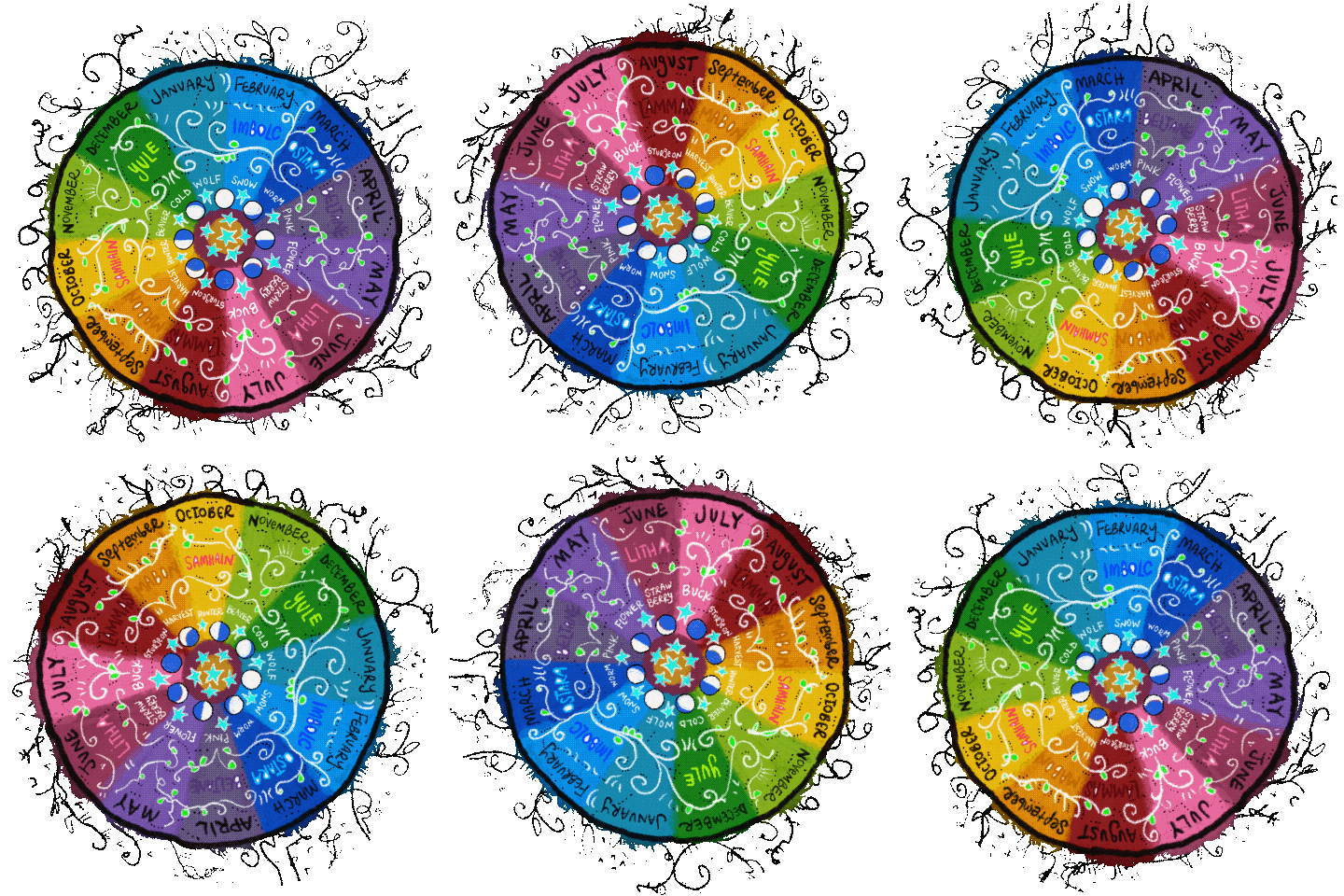
The Wheel of the Year is a modern, cyclical, and neo-pagan calendar marking eight seasonal festivals known as Sabbats, celebrating the earth's rhythms, agricultural cycles, and the sun's journey. It blends ancient Celtic, Germanic, and Druidic traditions with later Wiccan influences to honor the balance of light and dark.
The Eight Sabbats (Northern Hemisphere)
-
Yule (Winter Solstice – Dec 20–23): The longest night, honoring the rebirth of the Sun.
-
Imbolc (Feb 1): The first signs of spring, focusing on purification, light, and new beginnings.
-
Ostara (Spring Equinox – Mar 19–21): Day and night are equal, celebrating balance and fertility.
-
Beltane (May 1): A fire festival celebrating vitality, passion, and the peak of spring.
-
Litha (Summer Solstice – Jun 20–22): The longest day, celebrating the abundance of the sun.
-
Lughnasadh / Lammas (Aug 1): The first harvest festival, focusing on gratitude for early bounty.
-
Mabon (Autumn Equinox – Sep 21–23): The second harvest, focusing on balance, reflection, and gratitude.
-
Samhain (Oct 31): The third and final harvest, marking the Witches' New Year, honoring ancestors, and acknowledging the "thinning veil" between worlds.
Unlike the linear nature of the Gregorian calendar, the Wheel emphasizes that life, death, and rebirth are constant cycles, encouraging practitioners to live in harmony with nature's shifts.
The Wheel provides a framework to slow down, accept change, and move with the natural flow of the seasons rather than resisting.
While the European "Father Time" with a scythe represents a linear, often destructive, march toward death, many other cultures, particularly Hindu, Mayan, and various Indigenous traditions, perceive time as a sacred, repeating, and often spiral-like phenomenon. Instead of a personified old man, these cultures often use symbols like wheels, snakes, or seasons to represent the unending cycles of creation, destruction, and renewal.
Here is a detailed look at cyclical time in folklore, beliefs, and figures:
Hindu Cosmology: Kala Chakra (The Wheel of Time)
In Hinduism, time is viewed as eternal and cyclical, without a definitive beginning or end. It is described as a vast, rotating wheel (Kala Chakra).
-
Cycles of Creation and Destruction (Kalpas): The universe undergoes endless cycles, moving from creation (srishti), to preservation (sthithi), and finally to dissolution (laya or pralaya), at which point it is recreated.
-
The Yugas (Ages): Time is divided into four epochs that run in a cycle, progressively degenerating in virtue:
-
Satya Yuga: The Golden Age of truth and righteousness.
-
Treta Yuga: Virtue declines slightly.
-
Dvapara Yuga: Further imbalance occurs.
-
Kali Yuga: The current, final age of darkness, ignorance, and conflict.
-
-
Figures & Beliefs:
-
Lord Shiva: As the destroyer in the divine triad, Shiva is associated with the end of time, performing the Tandava (dance of destruction) to bring about the end of an era.
-
Lord Vishnu: Through his avatars, such as Kalki, Vishnu marks the end of the Kali Yuga and the beginning of a new Satya Yuga.
-
Kaal (Time): Often regarded as the ultimate, impersonal force that controls life, acting as both the creator and destroyer.
-
Mayan Time: Interlocking Cycles and the "Spiral"
The Maya civilization had a complex, multi-layered, and highly accurate calendar system based on the belief that time is cyclical and that days have specific, recurring characteristics.
-
The Calendars: The Maya used interlocking cycles, primarily the Tzolk'in (260-day sacred cycle, often linked to human gestation) and the Haab (365-day solar year).
-
The Long Count: A linear count used to track large, historical, and mythological epochs (such as the 13 B'ak'tun cycle that ended in 2012).
-
Figures & Beliefs:
-
The Maize God: Symbolizes the cycle of rebirth and seasons. He is decapitated during harvest and reborn in the new growing season.
-
Spiral Time: Many Mayan traditions view time not just as a circle but as a spiral. Endings are seen as "turning" points, where the new cycle begins at a different, often higher, level of understanding.
-
The Five Worlds: Similar to the Yugas, some Mesoamerican traditions believe they are currently living in the fifth world, with four previous worlds having been destroyed and reconstructed.
-
Indigenous Worldviews: The Medicine Wheel
Many Indigenous, particularly Native American, cultures view time as circular or, more often, spiraling, with a strong emphasis on the interconnectedness of past, present, and future.
-
The Medicine Wheel: A central symbol representing balance and harmony. It represents the four directions, four seasons, and four stages of life (birth, youth, adulthood, elder), embodying continuous movement.
-
Nature-Based Time: Time is often dictated by agricultural cycles, animal migrations, and celestial events rather than arbitrary, linear, mechanical clocks.
Father Time is the Western personification of time, embodying the relentless progression of history, aging, and mortality. Primarily depicted as an elderly, bearded man with a flowing robe, he often carries a scythe and an hourglass, symbolizing life's inevitable harvest and the finite duration of existence. His imagery has evolved through various cultures, merging agricultural gods with abstract concepts of temporal flow.
Names Across Cultures and Traditions
-
Chronos/Khronos: Greek God of Time (personified).
-
Cronus/Kronos: Greek Titan (agricultural, associated with the scythe).
-
Saturn: Roman equivalent to Cronus.
-
Zurvan: The Zoroastrian concept of infinite time.
-
The Holly King/Old Man Winter: Celtic/European myths of the dying god of the year (often bearded, wearing robes).
-
Ouro Kronii: A modern interpretation (Hololive EN) known as the "Warden of Time," based on the Father Time archetype.
Imagine there's no heaven
It's easy if you try
No hell below us
Above us only sky
Imagine all the people
Living for today, ah
Imagine there's no countries
It isn't hard to do
Nothing to kill or die for
And no religion too
Imagine all the people
Living life in peace, you
You may say I'm a dreamer
But I'm not the only one
I hope someday you'll join us
And the world will be as one
Imagine no possessions
I wonder if you can
No need for greed or hunger
A brotherhood of man
Imagine all the people
Sharing all the world, you
You may say I'm a dreamer
But I'm not the only one
I hope someday you'll join us
And the world will live as one
Songwriter: John Winston Lennon

